An asbestos roof is nothing unusual in Belgium. For decades, asbestos cement was used extensively for artificial slates, corrugated sheets on extensions and garages, some underlays and flues. Its use has been banned since the late 1990s, but much of this material is still in place. Should you be worried? How can you tell if your roof is affected, and how do you replace it safely? Here are the essentials.
Where is asbestos found on a roof?
- Artificial slates made of fibre cement and laid before the late 1990s;
- grey corrugated sheets on extensions, garages, sheds and farm buildings;
- some underlays made of fibre cement sheets;
- chimney or ventilation flues in fibre cement;
- some cornice, cladding or verge elements;
- old gutters and downpipes made of fibre cement.
How can you recognise an asbestos roof?
You can never be sure by looking: fibre cement with and without asbestos look alike. A few clues can point you in the right direction, however:
- an installation date before the late 1990s;
- grey artificial slates, often slightly bowed or chipped at the edges;
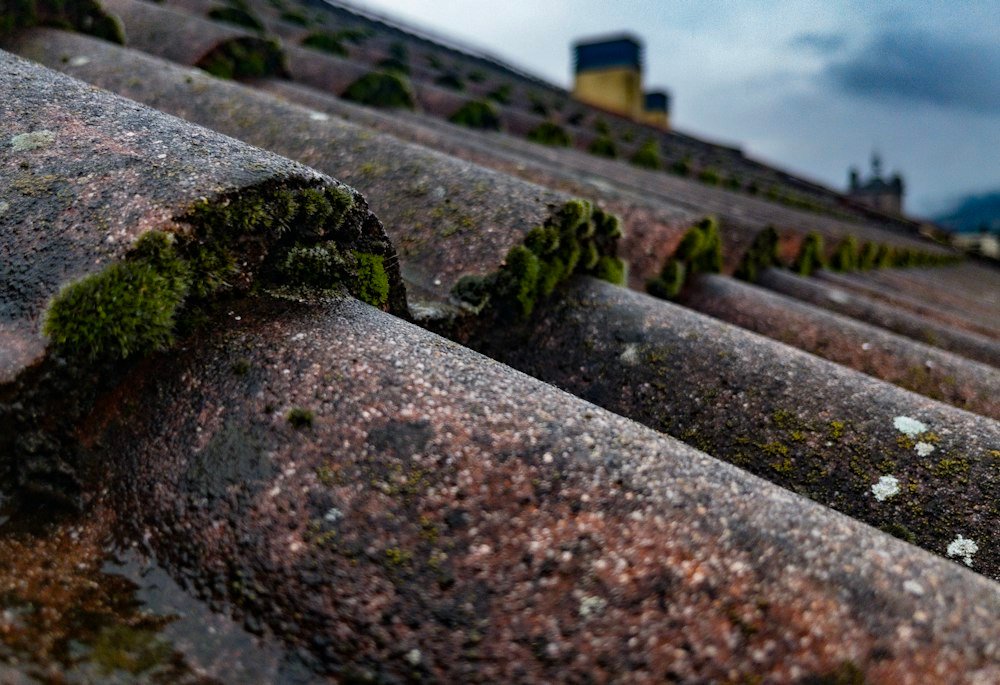
- grey corrugated sheets, sometimes covered in moss;
- no marking on the back of the elements indicating an asbestos-free composition.
Only a laboratory analysis of a sample taken by a professional gives certainty. Never break off a piece yourself to take a sample.
Is an asbestos roof dangerous?
Asbestos is dangerous when its fibres are released into the air and inhaled. In asbestos cement, the fibres are bound by the cement: as long as the material is in good condition and left alone, the risk is low. The danger arises when the material deteriorates badly, or when it is broken, drilled, sanded or cleaned with a pressure washer.
What you must never do
Never clean an asbestos roof with a pressure washer, never remove moss mechanically, never drill it, never break it and never throw it out with ordinary waste.
The rules in Belgium
Asbestos management is largely a regional matter, and the rules are changing. Some key points:
- In Flanders, OVAM runs a policy of gradual asbestos removal. An asbestos inventory certificate is required when selling buildings constructed before 2001, and the regional goal is to remove high-risk applications, including asbestos cement roofs, gradually according to a timetable set by the Region. Mijn VerbouwPremie also includes a supplement for removing a covering or underlay containing asbestos, combined with insulation.
- In Wallonia and Brussels, removal is governed by rules on worker protection and waste disposal. An asbestos inventory is often required before major demolition or renovation work.
- Everywhere, asbestos waste must be wrapped and taken to approved disposal channels, often via recycling centres for small quantities from private individuals, according to local rules.
Check with your region, your municipality or the waste management authority before any work: the precise conditions depend on your situation.
Removing an asbestos roof: how does it work?
- Identification and, if necessary, sample analysis.
- Preparation: protecting the surroundings, personal protective equipment, a work plan.
- Wetting the elements to limit the release of fibres.
- Careful dismantling, element by element, without breaking or drilling.
- Wrapping in sealed, labelled bags or sheeting.
- Removal to an approved disposal channel, with proof of disposal.
- Cleaning the area with suitable vacuum equipment.
Depending on the type and quantity of material, and on regional rules, removal must be entrusted to a specialist asbestos removal company. Toiture En Ligne coordinates these operations with licensed partners, then installs the new covering.
Replacing an asbestos roof
Once the asbestos has been removed, it is an opportunity to start again with a healthy, high-performance roof:
- natural slates or modern asbestos-free artificial slates;
- clay or concrete tiles, if the pitch and planning rules allow;
- insulated sandwich panels or steel sheets for extensions and garages;
- and above all, effective insulation, which often determines access to grants.
See our slate roof and roof renovation pages.
Overcladding instead of removal?
Covering an asbestos roof with a new covering is sometimes suggested to avoid the cost of removal. This solution postpones the problem, adds weight to the structure and may be restricted by regional rules. It has to be assessed case by case. In most renovation projects, removal remains the healthiest and most durable solution.
What about extensions, garages and sheds?
Asbestos cement corrugated sheets are very common on garages, carports and garden sheds. They are often the most deteriorated elements, as they are less well maintained. Replacing them with insulated sandwich panels, steel sheets or a flat roof is quick and simple once removal has been carried out.
What does it cost?
The cost of removal depends on the area, access, the type of material and the applicable rules. It comes on top of the cost of the new covering. In Flanders, the Mijn VerbouwPremie supplement for eligible income categories can reduce the bill, provided you insulate at the same time. We draw up a detailed quote after a visit.
An asbestos roof and selling your home
In Flanders, the seller of a building from before 2001 must provide an asbestos inventory certificate. An asbestos roof therefore becomes immediately visible to buyers and their notary, and often weighs on the price. Replacing it before the sale allows a more favourable certificate and avoids long negotiations.
Frequently asked questions
Can I live under an asbestos roof?
Yes, as long as the elements are in good condition and left alone. The risk arises with deterioration or building work. Planning its replacement in the longer term is still advisable.
Can moss be removed from an asbestos roof?
No mechanical or pressure cleaning should be carried out. A very gentle treatment may be considered in some cases, but replacement is often the best solution.
Does an asbestos roof lower the value of a house?
It can weigh on negotiations, all the more so in Flanders, where the asbestos certificate makes its presence visible at the time of sale. A planned replacement is a selling point.
In summary
An asbestos roof in good condition is not an emergency, but it must never be cleaned, drilled or broken without precautions. Its removal follows strict rules and must be entrusted to professionals. It is also an opportunity to insulate and start afresh with a healthy roof. Our teams support you in Brussels, Walloon Brabant, Hainaut and Flanders.